
Inverted Roller Screw Preload, Backlash, and Axial Rigidity: Engineering Trade-Offs, Drag Torque, and Procurement Guide
Specify inverted roller screw preload with clear backlash, rigidity, and drag torque limits. Use the engineering checklist to prepare a measurable supplier RFQ.
Inverted roller screw preload should be specified from the permitted reversal error and loaded deflection, then checked against running torque and temperature. “Zero backlash” alone does not define preload force, axial rigidity, or positioning accuracy. Request separate acceptance limits for each property rather than assuming that a preloaded assembly solves all three.
For an engineering drawing or RFQ, the practical trade-offs are:
- Reversal: removing axial clearance can reduce mechanical deadband when thrust changes direction.
- Rigidity: preload can improve contact stiffness, particularly near load reversal, but shaft, bearing, and housing compliance still limit the complete actuator.
- Drag and heat: preload can increase running torque; the amount depends on the actual assembly, lubrication, speed, and temperature.
- Life and cost: compare supplier calculations, inspection scope, quotations, and delivery commitments. There is no universal percentage penalty for all inverted screws.
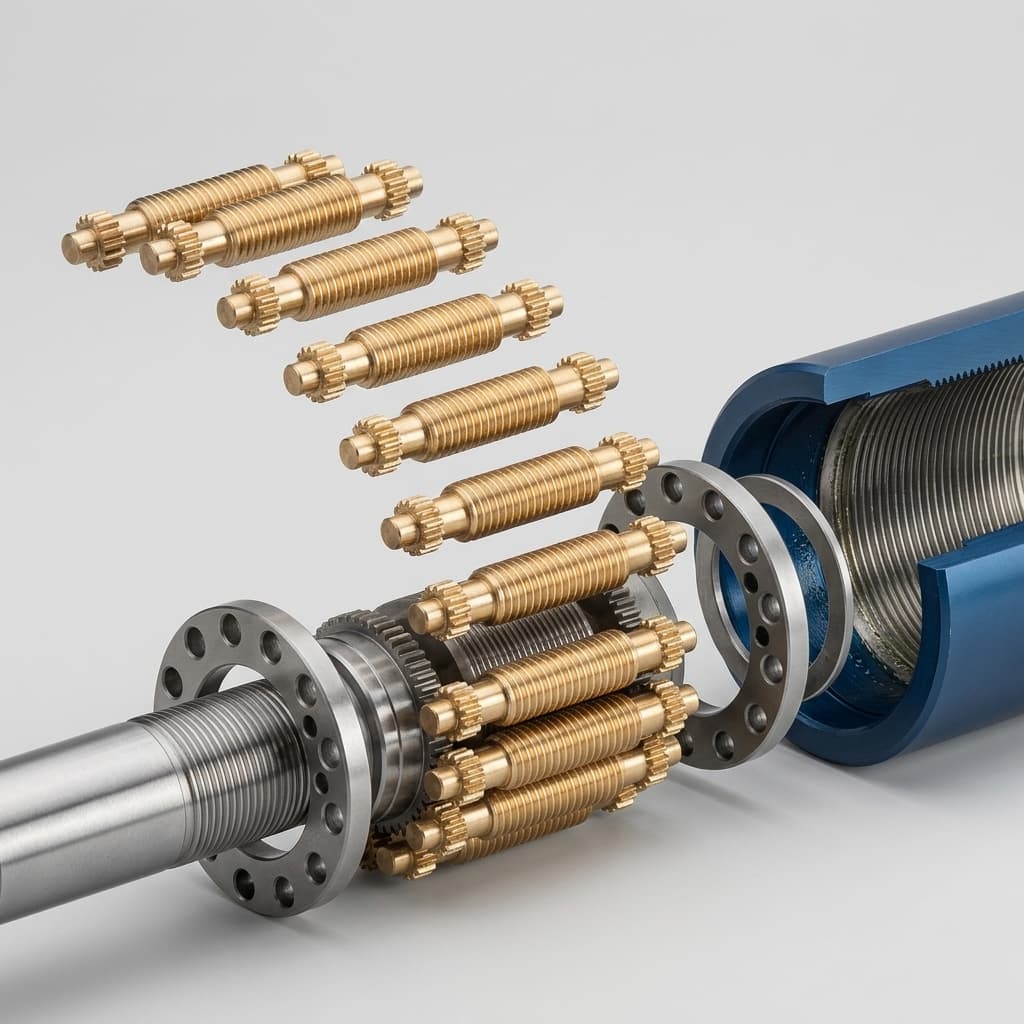
Published and last reviewed: October 29, 2026. Scope: global OEM linear actuator engineering and procurement, using SI units. This is a literature-based specification guide with explicitly hypothetical calculations, not a measured product test or qualification report. The cover image is an assembly illustration, not evidence of a particular preload mechanism. Final limits belong on the approved supplier drawing and acceptance procedure.
Preparing an actuator specification? Review the inverted planetary roller screw architecture or send your load profile and positioning tolerance for a feasibility review.
1. Backlash vs. Lead Accuracy vs. Axial Rigidity
These properties describe different contributors to output error:
- Lead accuracy: deviation between nominal travel and actual travel over a stated measuring length. It does not establish axial clearance at reversal. If using an accuracy grade, identify the standard, edition, error parameter, and measuring length instead of giving only a grade code.
- Axial clearance / backlash: free relative axial movement between screw and nut when the loaded flank changes. A measured actuator reversal loop can also include elastic deformation, friction, bearing movement, and fixture compliance; report the test force and setup.
- Axial rigidity: the local slope of the force–displacement curve,
R = ΔF / Δδ, over a stated load interval. Specify whether the measurement covers the screw contact alone or the complete actuator output.
ISO 3408-3:2006 concerns ball-screw acceptance tests. Its terminology can inform a supplier discussion, but citing it does not establish a universal inverted roller screw clearance class or test procedure. Agree explicitly on which provisions, if any, the supplier applies to the selected roller screw.
Why higher contact stiffness may give a small system improvement
For a simplified axial load path whose components act in series:
1 / R_total = 1 / R_contact + 1 / R_shaft + 1 / R_bearings + 1 / R_housingFor a hypothetical assembly, let these stiffnesses be 200, 100, 500, and 500 N/µm respectively. The resulting total is approximately 52.6 N/µm. Doubling only contact stiffness to 400 N/µm raises the total to approximately 60.6 N/µm, an improvement of about 15%. These are arithmetic examples, not catalogue values; real joints and nonlinear contact require load-dependent analysis.
This gives a useful design-review question: is the reversal gap the problem, or does the shaft or support structure dominate loaded deflection? There is no transferable “3× to 5×” stiffness advantage over every ball screw of the same diameter.
2. Inverted Roller Screw Contact Mechanics and Preload Architecture
An inverted arrangement uses a long internally threaded nut to accommodate travel in a compact actuator layout. The exact moving members, roller retention, motor integration, and preload arrangement depend on the design. Do not copy a conventional split-nut option into an inverted-screw RFQ without checking the supplier's assembly drawing.
Ewellix's Roller screws catalogue distinguishes axial play, backlash-free execution, and preloaded designs; its load–deflection comparison shows why these descriptions are not interchangeable. See the catalogue reference and access limitation in References below. That general comparison does not establish which preload methods are available for a particular inverted model.
3. Physical Preload Methods: What to Confirm with the Supplier
Selective roller matching
Ask whether the proposed assembly uses selected roller dimensions to reduce clearance or establish interference. Obtain the resulting axial-play and running-torque limits. A nominal roller-size difference alone does not establish delivered preload, and micron-level sorting tolerances must come from the supplier's process specification.
Geometric offsets or separated loaded sections
If a supplier proposes a pitch offset or opposed loaded sections, request a section drawing showing the load path, preload-setting method, and retention of the setting across travel and temperature. Treat this as a design-specific proposal; this guide does not establish it as a standard option for every inverted screw.
Compliant preload arrangements
If springs or other compliant elements are proposed, check the preload change over displacement and temperature as well as the added compliance and packaging length. A compliant arrangement may accommodate movement, but its actual stiffness and travel must be evaluated. Do not assume a tandem or split-nut design fits the inverted architecture.
4. Engineering Comparison: Clearance and Preload Acceptance
Use measurable requirements rather than assuming J/R/P0–P3 are universal industry classes. Supplier codes are meaningful only with that supplier's definitions. This table is an RFQ comparison framework, not a catalogue rating table.
| Requirement | Controlled-clearance proposal | Backlash-free or preloaded proposal | Evidence to request |
|---|---|---|---|
| Axial play | State the permitted gap in µm | Define a measurable reversal limit rather than mathematical zero | Force–displacement loop with test force, fixture, and uncertainty |
| Axial rigidity | State the load interval and output datum | Check the same interval, especially near reversal | Load–deflection curves for the specified assembly |
| Preload setting | Confirm whether intentional preload is absent | Define the setting method and supplier-defined force or torque criterion | Approved drawing and assembly acceptance record |
| Running torque | Measure actual grease, seals, speed, and temperature | Include preload under the same conditions | Mean, maximum, and variation across stroke and both directions |
| Thermal behavior | Verify clearance and output error after warm-up | Check torque and reversal behavior after warm-up | Duty-cycle test with sensor locations and agreed stop limits |
| Life calculation | Use the actual load and speed sequence | Include the supplier's preload load-sharing model | Rating basis, duty assumptions, lubrication, and calculated life |
| Lead accuracy | Specify travel-error parameter and measuring length | Specify it separately from preload | Lead-error inspection report using the agreed method |
| Cost and delivery | Quote the defined inspection scope | Quote matching, setting, and qualification separately | Itemized quotation, sample plan, and delivery commitment |
If two quotations use different test forces, grease fills, or measurement datums, their backlash and torque values are not directly comparable. Send both proposed acceptance conditions with the duty profile before choosing the lower-price assembly.
5. Drag Torque, Thermal Expansion, and Fatigue Life
Running torque and frictional heating
Use measured no-load running torque at the intended speed and temperature. Do not calculate preload drag by treating preload force as an external payload: internal opposing contact loads and friction do not follow that simple conversion.
At the screw input, a preliminary motor budget can separate useful-load torque, measured idle torque, and acceleration torque:
T_drive ≈ F_axial × lead / (2π × η_load) + T_idle + T_acceleration
P_idle = T_idle × 2π × n / 60
Here force is in N, lead in m/rev, torque in N·m, rotational speed n in rpm, and power in W. This bookkeeping assumes η_load excludes the losses already captured in T_idle; otherwise adding both double-counts losses. Include gearing, support bearings, and seals consistently with the measurement boundary.
Hypothetical heat-budget example: with an assumed idle torque of 0.30 N·m at 2,000 rpm, idle mechanical loss is approximately 62.8 W. At 10% rotating duty at that operating point, the time-average contribution is approximately 6.28 W, before other losses. Neither result predicts internal temperature; that requires thermal resistance, heat capacity, cooling, and the actual cycle. These assumed inputs are not a product claim.
Differential thermal expansion
A first screening relation is Δd = d × α × ΔT. For an assumed 30 mm steel diameter, α = 12 × 10⁻⁶ /K, and a 30 K temperature rise, free diameter growth is 10.8 µm. This is not automatically a 10.8 µm loss of clearance: the nut, rollers, shaft, supports, and housing also expand, at potentially different temperatures.
Thermal gradients can raise or lower effective preload depending on geometry and constraints. Avoid a generic “safe clearance” or a claim of inevitable exponential runaway. Record torque, temperature, and reversal behavior throughout the specified cycle; agree on allowable temperatures and torque before testing.
Fatigue life and load sharing
ISO 3408-5:2006 covers ball-screw load ratings and operational-life calculations. It does not, by itself, validate a roller-screw life exponent, internal preload load-sharing law, or fixed life reduction.
For the selected inverted screw, ask the supplier to include both thrust directions, preload, speeds, travel per cycle, lubrication, contamination assumptions, and shock events in its calculation. Separate statistical rolling-contact fatigue life from wear, lubricant life, and required inspection intervals. A universal 25%, 35%, or 50% life penalty is not a defensible purchase-order requirement.
6. Sizing Guide: When Do You Need Low Backlash?
| Application or observed problem | Candidate specification to investigate | Evidence required before release |
|---|---|---|
| Pressing with a consistently seated working flank | Controlled clearance may suit the loaded working stroke | Return-stroke positioning and every actual reversal meet the error budget |
| Bidirectional positioning with only motor feedback | Reduced clearance or backlash-free execution | Output reversal error stays within tolerance under changing thrust |
| Direct linear encoder at the output | Evaluate mechanical clearance with the control design | Endpoint accuracy, reversal settling, stability, and disturbance response |
| Compact robot joint with frequent reversals | Compare low-clearance and preloaded candidates | Joint lost motion, thermal behavior, and dynamics across the duty cycle |
| Precision process sensitive to small load changes | Specified preload may improve low-load contact stiffness | Total output stiffness and hysteresis, including supports and housing |
| Flight-control or other safety-critical actuation | Follow the application's approved qualification process | System fault, load, dynamic, and environmental requirements; this guide cannot certify the mechanism |
For the packaging decision, see inverted vs. standard planetary roller screws. Architecture selection precedes agreement on a model-specific clearance or preload setting.
7. Procurement Checklist: Define Acceptance on the Drawing
- Separate requirements: list lead accuracy, axial play / reversal error, and loaded rigidity independently, with units and measurement boundaries.
- Application inputs: provide stroke, thrust in both directions, speed, acceleration, orientation, external guidance, and cycle timing.
- Clearance or preload definition: reference the supplier's drawing and code definition; specify the permitted output behavior.
- Reversal test: agree on positive and negative test forces, loading rate, stroke positions, dwell, fixture compliance, and uncertainty. No universal test force is assumed here.
- Rigidity test: specify the force interval, displacement datum, support arrangement, and whether frictional hysteresis is reported separately.
- Torque envelope: agree on breakaway and running-torque limits, mean and peak variation, speed, direction, temperature, seals, and lubrication condition.
- Thermal acceptance: define ambient conditions, installation and cooling, run duration, sensor positions, permissible temperatures, and post-warm-up reversal limits.
- Lubrication and alignment: use the intended lubricant and fill quantity; define mounting datums, allowable misalignment, and relubrication access.
- Life and overload review: obtain a calculation using the duty profile and supplier's preload model; review shock loads and static capacity separately.
- Records and change control: require inspection results linked to the supplied assembly and approval before changing roller matching, preload setting, grease, or acceptance method.
Example acceptance-note structure — fill in application-specific values before release: “At [temperature] with [lubricant and fill], measure output displacement relative to [datum] while cycling axial force between [negative force] and [positive force] at [stroke positions]. Report the complete loading and unloading loop. Permitted reversal displacement: [limit]; axial rigidity over [load interval]: [limit]; running torque at [speed]: [mean/peak limits].”
This template makes missing agreement visible; blank fields are not acceptable purchase specifications.
8. Frequently Asked Questions
Can a non-preloaded inverted roller screw have no reversal error under load?
A sustained load can keep one flank seated, so clearance may not appear during that portion of the cycle. The physical gap remains relevant when thrust reverses or a disturbance unloads the contact. Elastic deflection, friction, and support movement can still produce output error while the flank stays seated.
Does zero backlash mean high axial rigidity?
No. Backlash describes clearance-related lost motion; rigidity describes force-dependent displacement. A backlash-free screw can still have a compliant shaft or housing. Request both reversal measurements and load–deflection curves.
Why can running torque vary along the stroke?
Thread geometry variation, alignment, seals, lubricant distribution, and temperature can change running torque. Preload can increase sensitivity to geometric variation. Compare both directions under controlled conditions instead of assuming a universal acceptable ripple percentage.
Can software or a linear encoder replace mechanical preload?
Direct output feedback and compensation can improve endpoint positioning, but they do not remove the mechanical gap or restore passive stiffness through it. Reversal transients, settling time, stability, and response to external disturbances still need validation. An endpoint-accuracy result alone does not prove equivalent dynamic performance.
How should backlash be monitored over service life?
Establish an as-delivered baseline, then repeat the agreed reversal and torque tests at application-specific intervals under comparable conditions. Wear, lubrication, contamination, overload, and temperature history affect changes. This guide does not promise a fixed break-in increase or constant clearance throughout calculated fatigue life.
Should miniature inverted roller screws always avoid preload?
No universal diameter rule applies. Compare the proposed preload against motor torque margin, required reversal behavior, lubrication, assembly tolerances, and thermal limits. Request data for the actual miniature model rather than transferring a preload percentage from a larger screw.
9. Prepare a Comparable Supplier RFQ
Choose the least demanding clearance or preload arrangement that demonstrably meets the complete output-error budget and duty cycle. Release the specification when reversal behavior, loaded deflection, running torque, temperature, and life assumptions have agreed acceptance evidence.
For a new design, review inverted planetary roller screw integration. For proprietary geometry, review custom roller screw manufacturing. To discuss feasibility, send your actuator drawing, duty profile, and draft acceptance limits; identify which values are measured, calculated, or still to be confirmed.
References and Technical Standards
- ISO 3408-3:2006 — Ball screws: Acceptance conditions and acceptance tests. Official ISO record. Relevant to acceptance terminology; its ball-screw scope must not be presented as universal inverted roller screw conformity.
- ISO 3408-5:2006 — Ball screws: Static and dynamic axial load ratings and operational life. Official ISO record. Provides context for rating terminology, not evidence for the hypothetical examples or a model-specific roller-screw life calculation.
- Ewellix — Roller screws, PUB IL-05003/5-EN, January 2023. “Axial play and preload,” printed page 30, distinguishes clearance, backlash-free, and preloaded nut designs. Access limitation checked October 29, 2026: the legacy catalogue URL redirects to Schaeffler's media library; the section remains indexed under this URL. Search the library by publication code or request the edition from the publisher. No numeric product rating from that catalogue is adopted here; obtain current model-specific data before purchasing.
Author

Categories
More Posts
Integrating Inverted Roller Screws with Frameless Hollow-Shaft Motors: Direct-Drive Actuator Engineering, Thermal Management, and Procurement Guide
Integrate inverted roller screws with frameless hollow-shaft motors. Compare thermal paths, bearing interfaces and sourcing options, then prepare your OEM RFQ.
Inverted Roller Screw Life Calculation: Dynamic Load Ratings (Ca), Cubic Mean Equivalent Load (Fm), L10h Fatigue Formulas, and Procurement Guarantees
Calculate inverted roller screw life with Ca, cubic mean load Fm and L10h formulas. Check the worked duty cycle and RFQ checklist, then request a sizing review.
Inverted Planetary Roller Screw vs. Ball Screw: Which is Better for High-Load Actuators?
A detailed engineering comparison between inverted planetary roller screws and traditional ball screws for heavy-duty and compact robotic applications.