
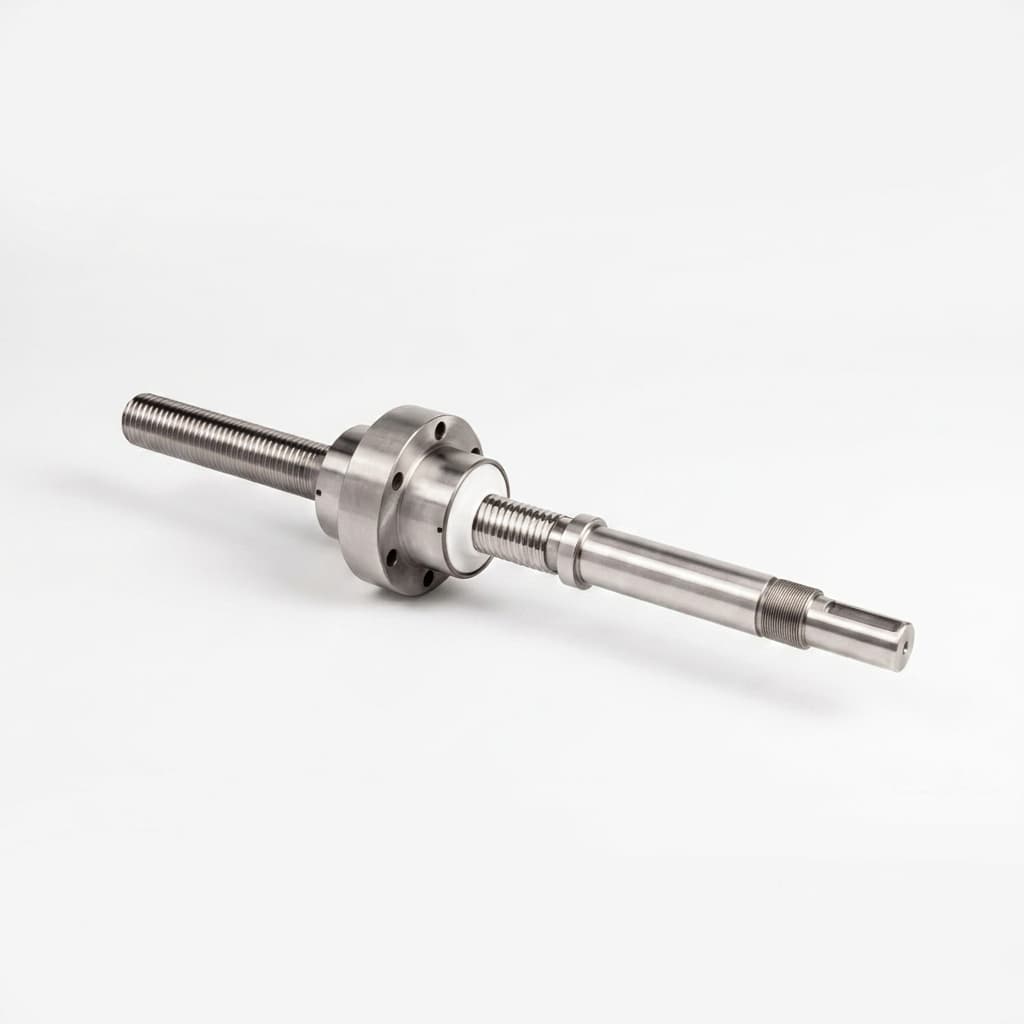
Replacing Hydraulic Cylinders with Inverted Roller Screws: A Total Cost of Ownership (TCO) Analysis
Use this TCO guide to compare hydraulic cylinders with inverted roller screws across energy, maintenance, ESG risk, precision, and migration limits.
For decades, fluid power—specifically hydraulic cylinder systems—has been the unquestioned king of high-force linear motion. From heavy metal stamping and injection molding to aerospace testing and heavy machinery, if you needed massive force density, you used hydraulics. However, the landscape of industrial automation and machine design is undergoing a profound shift. Driven by the dual imperatives of Environmental, Social, and Governance (ESG) compliance and skyrocketing energy costs, engineers and procurement teams are aggressively seeking electromechanical alternatives.
The technological enabler for this shift is the inverted planetary roller screw. By utilizing threaded rollers instead of recirculating ball bearings, roller screws can handle extreme shock loads and massive continuous forces that previously required a hydraulic cylinder. More importantly, the inverted design—where the nut travels along the screw, or the screw is integrated directly into the motor rotor—allows for unparalleled power density in a surprisingly compact package.
But transitioning from a legacy hydraulic infrastructure to a modern electromechanical actuator (EMA) requires a rigorous justification of the upfront capital expenditure (CapEx). Electromechanical systems carry a higher initial price tag than basic hydraulic cylinders. The true value, therefore, lies in the Total Cost of Ownership (TCO).
In this comprehensive guide, we deconstruct the TCO of inverted roller screws versus hydraulic actuators, providing procurement professionals, plant managers, and design engineers with a data-driven framework to make the right specification decision.
Scope, Assumptions, and Date of Analysis
This analysis was prepared on July 13, 2026 for global OEMs, factory automation teams, and procurement groups evaluating whether a high-force hydraulic cylinder axis should be replaced by an inverted roller screw electromechanical actuator. It is most applicable to production equipment with measurable duty cycles, repeatable motion profiles, and meaningful energy, maintenance, scrap, or contamination costs.
It is not a universal replacement rule. The estimates below should be recalculated with your measured force profile, local electricity tariff, operating hours, expected servo drive cost, maintenance logs, and required safety factor. For a first-pass model, calculate:
5-year TCO = installed CapEx + energy cost + preventive maintenance + unplanned downtime + consumables/fluid disposal + scrap/rework impact - residual value.
Use the comparisons as a specification framework, then validate the final actuator size against static load capacity, dynamic life, peak shock load, thermal limits, and controls compatibility.
1. The Core Differences in Actuation Mechanics
Before diving into the financial metrics, it is critical to understand the mechanical paradigms of both systems.
Hydraulic Actuators generate linear motion by utilizing a motor-driven pump to pressurize hydraulic fluid. This pressurized fluid is directed through a complex network of hoses, manifolds, and directional control valves into a cylinder, pushing against a piston. The force is a direct product of the fluid pressure and the piston surface area. While relatively simple at the actuator level, the system relies on a massive, centralized infrastructure known as the Hydraulic Power Unit (HPU).
Inverted Roller Screw Actuators convert the rotary motion of an electric servo motor into linear motion via a highly engineered mechanical transmission. Inside the actuator, planetary rollers with precise thread geometries orbit the main screw shaft. Because the load is distributed across multiple line-contacts (the threads of the rollers engaging with the nut), roller screws offer dynamic load capacities and shock resistance far exceeding those of traditional ball screws. When paired with a closed-loop servo system, they provide infinite, programmable control over position, velocity, and force without requiring external pumps or fluids.
As the chart illustrates, the procurement decision hinges on looking past the initial purchase order. Let's break down the individual components of TCO.
2. Energy Efficiency: The Silent TCO Killer
The most dramatic financial differentiator between hydraulics and electromechanical actuation is energy consumption.
Hydraulic systems are fundamentally inefficient at a systemic level. The typical overall mechanical and volumetric efficiency of a hydraulic system is often estimated around 40% to 55%. Why? Because maintaining system readiness requires the Hydraulic Power Unit (HPU) to run continuously in many legacy architectures. Even when the cylinder is holding a position or completely idle, the pump may still need to maintain baseline pressure in the accumulator and lines. Furthermore, moving fluid through valves and right-angle fittings generates friction, converting expensive electricity directly into waste heat. This heat can then require secondary energy consumption via chillers and heat exchangers to keep the oil from degrading.
Conversely, an inverted roller screw actuator paired with a modern servo drive can reach roughly 75% to 80% overall actuator efficiency, with screw-level efficiency varying by lead, preload, lubrication, and load profile. More importantly, it operates on a "power-on-demand" model. The system draws significant electrical current primarily when actively moving a load. When idle or holding a static position with a correctly specified brake, energy consumption can drop dramatically.
Procurement Consideration: When calculating TCO, do not look solely at the peak kW rating of the electric motor versus the hydraulic pump. You must calculate the duty cycle. For an application with a 30% active duty cycle, a legacy HPU may still draw meaningful standby power during idle periods, whereas the electromechanical system can be designed to consume very little energy when stopped. Over a 5-year, 3-shift operational lifespan, this energy delta can materially offset the higher purchase price of the roller screw actuator upgrade.
3. Maintenance, Fluid Management, and ESG Compliance
The hidden operational expenses (OpEx) of hydraulic systems extend far beyond electricity bills. Maintenance and environmental compliance represent a massive ongoing liability.
The Reality of Hydraulics: Hydraulic systems do not fail gracefully; they fail messily. Seals degrade over time due to pressure spikes, particulate contamination, and thermal cycling. Hoses fatigue and rupture. The system requires constant vigilance: changing filters, testing fluid viscosity, disposing of degraded oil, and constantly cleaning up the inevitable leaks.
These leaks are no longer just a "cost of doing business." In modern manufacturing facilities governed by strict ESG (Environmental, Social, and Governance) targets, hazardous fluid spills incur significant costs. There are direct costs for specialized cleanup materials and disposal services, safety hazards related to slip-and-fall injuries, and potential regulatory fines. Furthermore, in environments like food processing, pharmaceuticals, or cleanrooms, a single hydraulic leak can result in millions of dollars of ruined product and mandatory line shutdowns.
The Electromechanical Advantage: Inverted roller screws are entirely self-contained systems. They require no external pumps, no hoses, and no large reservoirs of environmentally hazardous fluids. Maintenance is generally limited to periodic re-lubrication (injecting a small amount of grease via a standardized zerk fitting) at calculated intervals based on travel distance. There is no fluid to degrade, no filters to change, and no risk of a catastrophic high-pressure oil leak. From an ESG compliance standpoint, replacing hydraulics with electromechanical actuators immediately eliminates a major source of factory floor pollution.
4. Performance, Precision, and Scrap Reduction
While energy and maintenance savings are easy to quantify on a spreadsheet, the improvements in process control can yield even greater financial returns through scrap reduction and increased throughput.
Hydraulic systems are susceptible to variations in fluid temperature. As hydraulic oil heats up during a shift, its viscosity changes, which directly alters the response time and velocity of the cylinder. Achieving precise positioning requires complex, expensive servo-hydraulic proportional valves and constant recalibration. Furthermore, hydraulic fluid is slightly compressible, leading to a "spongy" response during sudden load shifts.
Inverted roller screws provide absolute mechanical rigidity and infinite programmability. Paired with high-resolution absolute encoders, they can achieve positioning repeatability down to the micron level, regardless of ambient temperature. Operators can program exact motion profiles—specifying precise acceleration, steady-state velocity, force limits, and deceleration curves on the fly.
The ROI Impact: If your machine is pressing, riveting, or dispensing, the superior force control and positional accuracy of a roller screw reduces the number of out-of-tolerance parts. Decreasing your scrap rate by even 1% over a year can dramatically accelerate the ROI of the actuator upgrade.
5. TCO Comparison Matrix
To simplify the procurement analysis, we have aggregated the critical comparative dimensions into a structured evaluation matrix.
| Evaluation Metric | Hydraulic Cylinder System | Inverted Roller Screw Actuator | TCO Impact |
|---|---|---|---|
| Initial Capital Expenditure (CapEx) | Low to Medium. Cylinders are cheap, but HPUs, valves, and piping add infrastructure costs. | High. Precision ground screws, servo motors, and drives require significant upfront investment. | Favors hydraulics initially; break-even must be modeled from duty cycle and site costs. |
| Energy Efficiency | Poor (about 40-55% system efficiency in many comparisons). HPUs often run continuously, wasting energy as heat. | Excellent (about 75-80% overall actuator efficiency, application-dependent). Power-on-demand; low idle draw when properly configured. | Often favors electromechanical systems in high-duty or multi-shift production. |
| Maintenance & Labor | High. Requires fluid changes, filter replacements, seal repairs, and leak management. | Low. Minimal maintenance. Requires only periodic greasing based on travel distance. | Significant reduction in OpEx and unplanned downtime for Electromechanical. |
| Environmental & Safety (ESG) | High Risk. Prone to oil leaks. High disposal costs for hazardous fluids. Fire hazards. | Low Risk. Self-contained electric system. Clean operation suitable for sensitive environments. | Protects against compliance fines and reduces cleanup overhead. |
| Footprint & Integration | Large & Disjointed. Requires centralized HPUs, routing of rigid lines, and bulky valve manifolds. | Compact. Inverted design integrates the screw into the motor housing. Only requires a single electrical cable run. | Saves valuable factory floor space and simplifies machine design. |
| Control & Precision | Moderate. Susceptible to temperature fluctuations and fluid compressibility. Complex to tune. | Superior. Infinite control over motion profiles. Rigid mechanical transmission yields high repeatability. | Reduces scrap rates and improves final product quality. |
6. When NOT to Upgrade: The Boundaries of Electromechanical Actuation
As an objective engineering organization, we must clearly define the application boundaries where inverted roller screws are not the optimal choice. Hydraulic systems still retain an edge in specific edge cases, and those cases should be screened before any conversion program:
- Extreme Shock Loads with No Relief: In applications like mega-tonnage forging presses or rock crushers, the system must survive violent, instantaneous shock loads. Hydraulic fluid is inherently forgiving; pressure relief valves can instantly dump fluid to prevent catastrophic mechanical failure. An electromechanical system relies on the physical strength of the steel threads. If the shock load exceeds the ultimate yield strength of the roller screw, permanent deformation (brinelling) will occur.
- Infinite Holding Force with Zero Power: If an application requires a massive load to be held perfectly stationary for days or weeks (e.g., flood gates or heavy civil engineering locks), a hydraulic cylinder can be locked with a valve, consuming zero energy and generating no heat. While an electric actuator can use a mechanical holding brake, extremely high-force holding often necessitates keeping the servo motor energized, which generates heat.
- Space Constraints at the Point of Actuation: If the absolute physical space at the moving joint is microscopic, a simple hydraulic piston is the smallest possible force-generation device (because the bulky motor and pump are located meters away). An electromechanical actuator must house the screw, nut, and motor at the point of action.
7. The Procurement & Engineering Migration Checklist
If you are evaluating a transition from hydraulics to inverted roller screws, use this checklist to ensure a successful specification and procurement process.
- Audit the True Duty Cycle: Do not just read the maximum force off the existing hydraulic pump. Use load cells and data loggers to measure the actual force required and the exact percentage of time the actuator is moving versus idle.
- Calculate the Total Baseline Energy: Work with your facilities team to measure the continuous kW draw of the existing Hydraulic Power Unit over a standard 40-hour or 120-hour production week.
- Quantify Maintenance Labor: Pull maintenance logs for the past 12 months. Tally the hours spent changing filters, cleaning leaks, and replacing seals on the specific machine.
- Determine the Peak Transient Load: Ensure you are sizing the inverted roller screw's static load capacity ($C_0$) to survive the absolute peak shock load the machine experiences, not just the continuous running load.
- Review Environmental Constraints: Confirm the IP rating required. While roller screws are sealed, extreme washdown environments (IP69K) require specific housing materials and specialized rod seals.
- Assess the Control Architecture: Verify that your current PLC or industrial network (EtherCAT, PROFINET, Ethernet/IP) can integrate seamlessly with the new servo drive required to run the electromechanical actuator.
If you want this checklist converted into a project-specific sizing worksheet, contact our engineering team with the current cylinder bore, stroke, pressure, cycle time, and duty cycle.
8. Frequently Asked Questions (FAQ)
Q: How long does it typically take to see a positive ROI when replacing a hydraulic system with an inverted roller screw? A: It depends on duty cycle, local energy cost, maintenance history, scrap rate, and the cost of the servo system. In high-duty manufacturing applications, a 18 to 24 month payback can be realistic, but it should be treated as a model result rather than a universal rule. For machines running 24/7/365, energy and maintenance savings can shorten the payback period substantially.
Q: Can an inverted roller screw match the force output of a large hydraulic cylinder? A: Yes, up to a certain point. Modern high-capacity planetary roller screws can deliver continuous thrust forces exceeding 100,000 lbf (445 kN). However, for multi-million pound requirements (like massive civil infrastructure projects), hydraulics remain the only viable option.
Q: Do inverted roller screws require cooling systems? A: In most applications, no. Because electromechanical conversion losses are much lower than many hydraulic systems, heat generation is usually manageable through the actuator housing. However, in applications with extremely high continuous duty cycles and heavy loads, optional liquid-cooling jackets can be integrated into the actuator housing to dissipate heat from the servo stator and screw nut.
Q: What happens if the actuator hits a hard stop? A: Unlike hydraulics which can simply bypass fluid, hitting a hard stop at full velocity with an electromechanical actuator transfers all kinetic energy into the mechanical components. It is critical to program software limits in the servo drive and use energy-absorbing bumpers or limit switches to prevent mechanical crashing.
9. References and Sources
To further your research on electromechanical efficiency, hydraulic conversion methodology, fluid management, and safety constraints, consult the following resources:
- Hydraulic-to-electric actuator sizing and efficiency comparison – Tolomatic white paper (PDF)
- Hydraulic cylinder conversion workflow – Tolomatic engineering guide (How To Convert Hydraulic Cylinders to Electric Actuators)
- Roller screw versus ball screw high-force application notes – Tolomatic resource center (How Roller Screw and Ball Screw Actuators Compare in High-Force Applications)
- Used oil handling and disposal obligations – U.S. Environmental Protection Agency (Managing Used Oil: Answers to Frequent Questions for Businesses)
- Hydraulic fluid safety hazard context – U.S. Occupational Safety and Health Administration (Potential Flammability Hazard Associated with Bulk Transportation of Oilfield Exploration and Production Waste Liquids)
Next Steps
Migrating from fluid power to electromechanical actuation is a significant engineering leap, but the long-term TCO reductions and ESG benefits are undeniable. Our application engineering team specializes in replacing legacy hydraulic infrastructure with state-of-the-art inverted planetary roller screws.
Ready to see how an inverted roller screw can optimize your machine design? Contact our engineering team to request a comprehensive TCO analysis, custom sizing charts, and 3D CAD models tailored to your specific load profile. Or, explore our complete line of Inverted Roller Screw Actuators for high-force automation.
Author

Categories
More Posts
How to Select the Right Inverted Roller Screw for Humanoid Robot Joints
A comprehensive sizing and selection guide for robotics engineers integrating inverted roller screws into bipedal humanoid actuators.
Inverted Roller Screw Supplier Selection: 5 Quality Control Metrics Procurement Must Check
A comprehensive supplier audit checklist for procurement teams and engineers evaluating inverted roller screw manufacturers, covering ISO standards and metrology.
Inverted vs. Standard Planetary Roller Screws: Engineering & Procurement Guide
A comprehensive decision framework comparing standard and inverted planetary roller screws. Learn the engineering trade-offs in load capacity, packaging, cost, and lubrication.